
// integrations
The Praxys Integrations Catalog: business capabilities at the API boundary
Substrate / Engineering · 4 minute read
The Praxys Substrate defines typed contracts for the capabilities an application needs. The integrations catalog puts those contracts to work: a growing collection of adapters for the business systems that connect a product to the outside world.
It covers the APIs that make a business operate: collecting payments, synchronising commerce, verifying identity, reaching customers, and using AI models. The repository includes a broad catalog of provider adapters against backend abstractions; the business-facing domains account for a large share of that implementation work.
Turning external APIs into product capabilities
Every ambitious application eventually encounters the same integration backlog. A payment provider has its own customer, subscription, and webhook models. A commerce platform has its own catalog and order model. An identity provider has its own verification flow. Each API brings credentials, versioning, operational limits, retries, webhooks, and edge cases that must be understood and maintained.
Building those connections one application at a time is expensive—and it leaves each product with a slightly different interpretation of the same business problem. The Praxys integrations catalog centralises that work behind deliberately designed contracts.
At the application boundary, teams work with a capability rather than a vendor SDK. A payment flow asks to create a checkout session, capture an invoice, or process a refund. A commerce workflow reads products, orders, and inventory. A KYC workflow starts a verification case and receives an outcome. The adapter translates between that stable product-facing model and the provider's API.
The result is not that every provider becomes identical. They are not. Praxys preserves meaningful differences through explicit capability flags and provider-specific escape hatches, rather than pretending that the lowest common denominator is sufficient. But the common workflows, error model, lifecycle, and event shapes remain consistent.
The business integrations we focus on
The catalog covers the business capabilities that commonly determine whether an application is ready to operate in the real world:
- Payments and financial data cover payment processors, bank-data aggregation, buy-now-pay-later services, and income verification. Adapters such as Stripe, Razorpay, Adyen, PayPal, Klarna, and Plaid map provider behavior into focused financial contracts.
- Commerce operations cover storefronts and marketplaces alongside the systems around them: inventory, tax, fulfillment, logistics, returns, subscriptions, loyalty, reviews, accounting, and product feeds. This includes platforms such as Shopify, Amazon, BigCommerce, eBay, and TikTok Shop.
- Identity, fraud, and compliance provide authentication, KYC, electronic identity, address validation, fraud signals, and PII tooling. These integrations support regional requirements as well as global providers, with consent and verification evidence treated as first-class concerns.
- Customer communications include transactional email, SMS, voice, push, chat, marketing automation, and support systems. Teams can connect providers such as Resend, Twilio, SendGrid, Klaviyo, HubSpot, and Zendesk through contracts appropriate to each channel.
- AI providers give applications a common route to leading model platforms, including Anthropic, OpenAI, Google, Amazon Bedrock, Mistral, Groq, and OpenRouter.
This breadth is useful because real products rarely need only one connection. A commerce business may need a storefront, tax calculation, inventory, fulfillment, customer messages, fraud checks, and payments to work together. The catalog reduces the amount of one-off integration code required to make that happen.
Rigor where systems meet
The API boundary is where reliability often leaks. Providers return different errors, retry semantics, and webhook formats; some offer features that others do not. Praxys handles this complexity at the adapter boundary, where it can be tested once and reused.
Core contracts define normalised data shapes, error vocabularies, lifecycle expectations, and capability declarations. Many include a reusable conformance harness, so an adapter must demonstrate the behavior the contract promises—not merely expose similarly named methods. For example, payment and commerce adapters normalise inbound provider events, while their provider-specific implementations verify webhook signatures before an event is accepted.
This design gives application teams a predictable surface without concealing important differences. Code can rely on the common contract for normal operations, then deliberately check a declared capability when it needs a provider-specific feature. Adding or replacing a provider is therefore bounded at the composition and integration layer, rather than spreading provider logic throughout the product.
The catalog at a glance
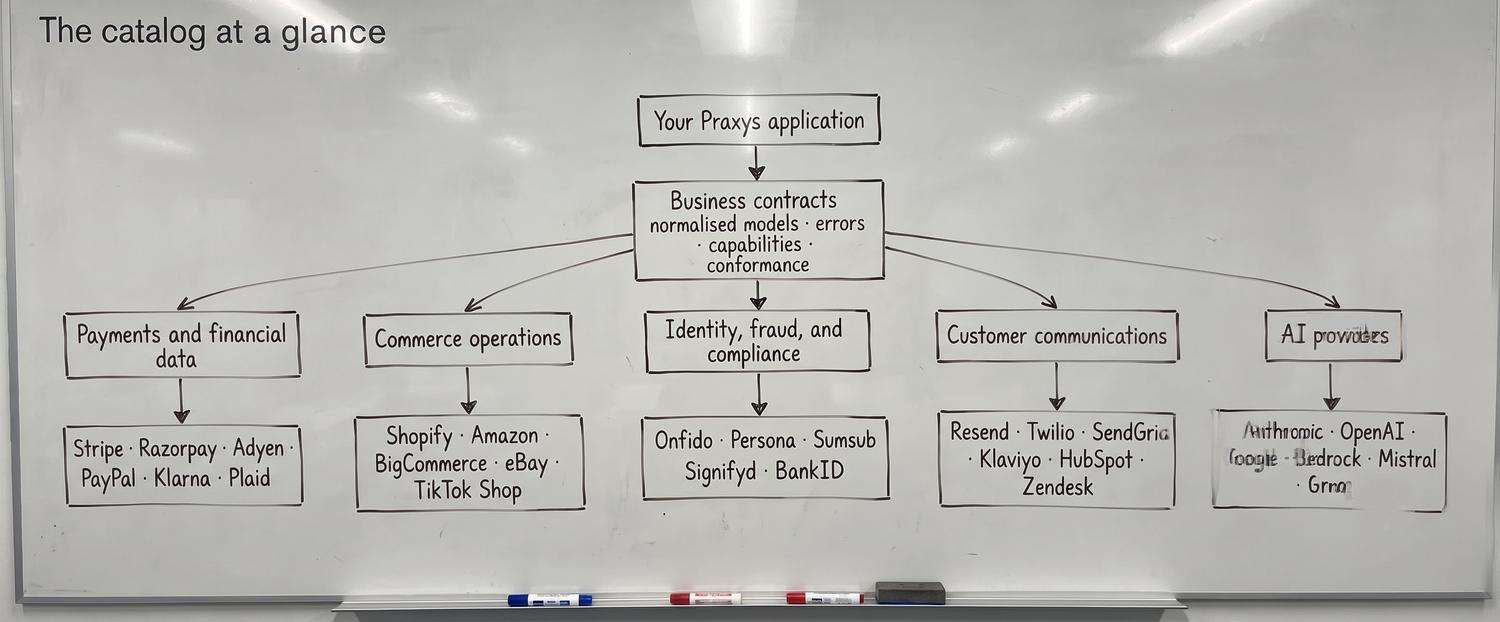
An application depends on a business contract. A chosen adapter implements that contract against a real provider. The adapter contains the vendor-specific translation; the application retains a stable model for the work it needs to do.
What this changes for product teams
For teams building on Praxys, the catalog turns a significant amount of undifferentiated integration work into a platform capability. The goal is not to eliminate engineering judgment: providers differ in markets, features, pricing, and operational characteristics. The goal is to ensure that choosing one does not require reinventing secure API access, event translation, error handling, and contract tests.
That is the value of the Praxys integrations catalog. It lets teams assemble reusable business capabilities from shared building blocks, while keeping vendor-specific complexity where it belongs: at a well-defined, tested boundary.
Request access.
Praxys is in builder preview. Join the list to build software you own.